| Vergina, the royal capital of Macedonia
(2006)
|
| Afbeelding Voorkant |
Boek Gegevens |
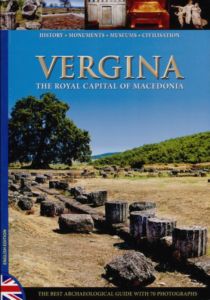
|
| Auteur |
|
| Genre |
cultuur; fotoboek; geschiedenis; kunst; naslag |
| Publicatie Datum |
2006 |
| Medium |
slappe kaft |
| Uitgever |
Summerdrean Editions |
| Taal |
engels |
|
|
| Verhaal |
Vergina ( ?e????a) is a small town in northern Greece, part of Veroia municipality in Imathia, Central Macedonia. Vergina was established in 1922 in the aftermath of the population exchanges after the Treaty of Lausanne and was a separate municipality until 2011, when it was merged with Veroia under the Kallikratis Plan. It is now a municipal unit within Veroia, with an area 69.047 km2.
Vergina is best known as the site of ancient Aigai (???a?, Aigaí, Latinized: Aegae), the first capital of Macedon. It was there when in 336 BC Philip II was assassinated in the theatre and Alexander the Great was proclaimed king. The ancient site was discovered in 1976 and excavated under the leadership of archaeologist Manolis Andronikos. The excavation unearthed the burial sites of many kings of Macedon, including the tomb of Philip II, father of Alexander the Great, which, unlike so many other tombs, had not been disturbed or looted. It is also the site of an extensive royal palace. The archaeological museum of Vergina was built to house all the artifacts found at the site and is one of the most important museums in Greece.
Aigai has been awarded UNESCO World Heritage Site status as "an exceptional testimony to a significant development in European civilization, at the transition from classical city-state to the imperial structure of the Hellenistic and Roman periods".
The funeral of Philip II in 336 BC was performed, as imposed by tradition, in Aigai. It was the most lavish funeral ceremony of the historic times held in Greece. In a monumental death chamber, laid on an elaborate gold and ivory deathbed wearing his precious golden oak wreath, the king was surrendered, like a new Hercules, to the funeral pyre. Alexander is now the king of Macedon. A “high priest” and a mystis (the initiated one), a hunter and a “symposiast”, an army leader and a legislator, Philip, the hero, descends to his eternal residence, which is reached by a ramp and has the form of an underground barrel-vaulted building with two chambers and a monumental façade. The concept of the “Macedonian tomb”, similar to the platonic concept of the leaders’ burial in an ideal state, interweaves a palace and a temple. The portraits of the two kings, father and son, are depicted in the hunting scene of the tomb’s façade, as well as on the gold and ivory deathbed in the chamber.
In the tomb’s antechamber, Philip’s Thracian wife, Meda, is buried with him. |
| Persoonlijke Gegevens |
| Verzamel Status |
In verzameling |
| Aanschafprijs |
10.00 € |
| Aanschafdatum |
5/06/2019 |
| Index |
1069 |
| Gelezen? |
Ja |
| Koppelingen |
Link
Vergina
Vergina Wikipedia
|
|
| Product Gegevens |
| ISBN |
9789607438337 |
| Land |
Griekenland |
| Aantal pagina's |
62 |
| Eerste Uitgave |
Nee |
| Zeldzaam |
Nee |
|
|